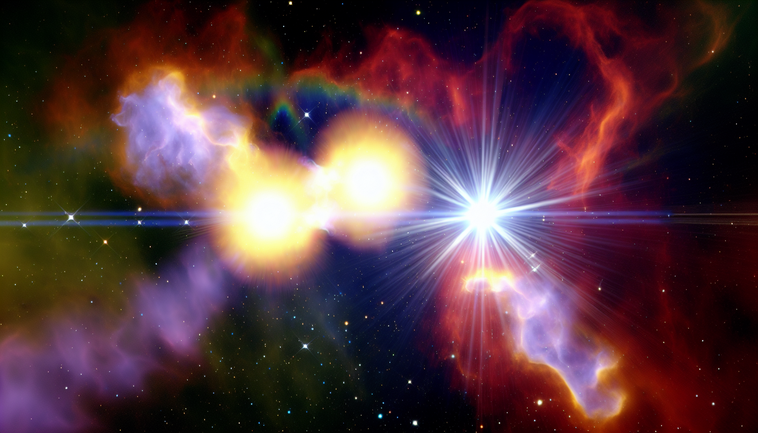
When the Hubble Space Telescope focuses its powerful gaze on a vibrant star-forming region, the result is nothing short of breathtaking. This week’s ESA/Hubble Picture of the Week zeroes in on a section of the N159 complex, a dynamic cradle of newborn stars nestled in our galactic neighborhood. Far from a static snapshot, the image captures a moment in an ongoing cosmic dance where matter and light intertwine.
In the full-color view, wisps of ionized gas glow with shades of crimson and pastel blue, curling around stellar nurseries like ribbons around a gift. Bright pinpricks of young stars pierce through the haze, each point of light marking a furnace where nuclear fusion has just ignited. The interplay of heated gases and dark dust lanes carves out cavernous voids and filaments that seem to stretch into infinity.
What makes this snapshot so compelling is the clear evidence of feedback processes at work. Stellar winds and radiation from hot, massive stars are blowing back the surrounding material, sculpting the gas into arcs and bubbles. These fierce outflows can both inhibit and trigger new waves of star formation, creating a self-perpetuating cycle that shapes the region’s evolution over millions of years.
Studying N159 in such detail is crucial for astronomers seeking to understand how stars emerge from cold molecular clouds. By comparing the density, temperature, and motion of the gases here, researchers can refine models of cloud collapse and fragmentation. Every bright rim and shadowy lane offers a data point in the quest to chart the life cycles of stars from cradle to grave.
From my perspective, what stands out is the sheer complexity revealed by Hubble’s optics. Rather than a uniform field, N159 is a tapestry of competing forces—gravity pulling gas inward, radiation pushing it outward, and magnetic fields weaving an invisible framework. Observing these elements in concert provides a unique laboratory for testing theories of interstellar chemistry and fluid dynamics on a grand scale.
Looking ahead, this image reminds us of the synergy between space- and ground-based observatories. While Hubble highlights fine structures with optical clarity, other telescopes operating at infrared or radio wavelengths can peer through thicker dust and reveal colder components. Combined data from these platforms will sharpen our view of stellar nurseries and pave the way for next-generation instruments to probe even deeper.
In conclusion, the ESA/Hubble Picture of the Week featuring the N159 region is more than a striking image—it’s an invitation to explore the forces that forge stars and shape galaxies. As we unpack each glowing filament and dark pillar, we come closer to answering fundamental questions about our place in the universe. N159 stands as a testament to the artistry of cosmic creation and the power of human curiosity.