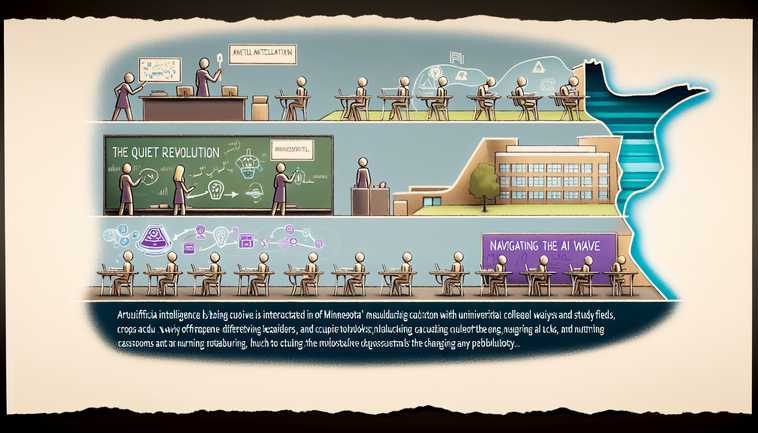
In recent months, a quiet revolution has swept through college and university corridors across Minnesota. Artificial intelligence tools are no longer confined to research labs or tech startups. Students and faculty are bringing them into lecture halls, study groups, and administrative offices, reshaping the very nature of teaching and learning.
Professors at institutions from the University of Minnesota to liberal arts colleges are grappling with how to integrate these new capabilities. Some have revamped assignments to require AI reflection and critique. Others are experimenting with AI-powered grading assistants to handle routine feedback, freeing up more time for personalized mentoring.
Yet alongside this surge of creativity, concerns about academic honesty have emerged. Rumors of term papers composed entirely by chatbots have prompted honor boards to revisit their policies. Faculty are revising syllabi to define clear boundaries for AI use and to design assessments that emphasize critical thinking over formulaic responses.
Beyond the question of integrity, AI is opening doors to fresh opportunities. Students can now use language models to overcome writing hurdles or to brainstorm interdisciplinary research ideas. In classrooms short on resources, these tools help simulate one-on-one tutoring, offering instant feedback on problem sets and fostering a more inclusive learning environment.
At the same time, colleges are navigating tight budgets amid federal funding uncertainties. Some administrations are investing in AI infrastructure, hoping that efficiency gains—from automated scheduling to predictive analytics—will offset rising costs. Others proceed with caution, concerned about hidden expenses related to software licensing and data privacy safeguards.
From my perspective, Minnesota’s experience offers a valuable blueprint for the rest of higher education. It shows that embracing innovation need not conflict with academic standards. With transparent policies, ongoing faculty training, and open dialogue with students, institutions can harness AI’s promise without sacrificing rigor.
Ultimately, artificial intelligence represents a tool whose impact depends on human choices. As Minnesota campuses continue adapting, they demonstrate that responsible adoption—rooted in collaboration, ethics, and strategic investment—can transform challenges into opportunities. The future of higher education may well hinge on our ability to balance ingenuity with integrity, ensuring that AI elevates the learning journey for every student.